
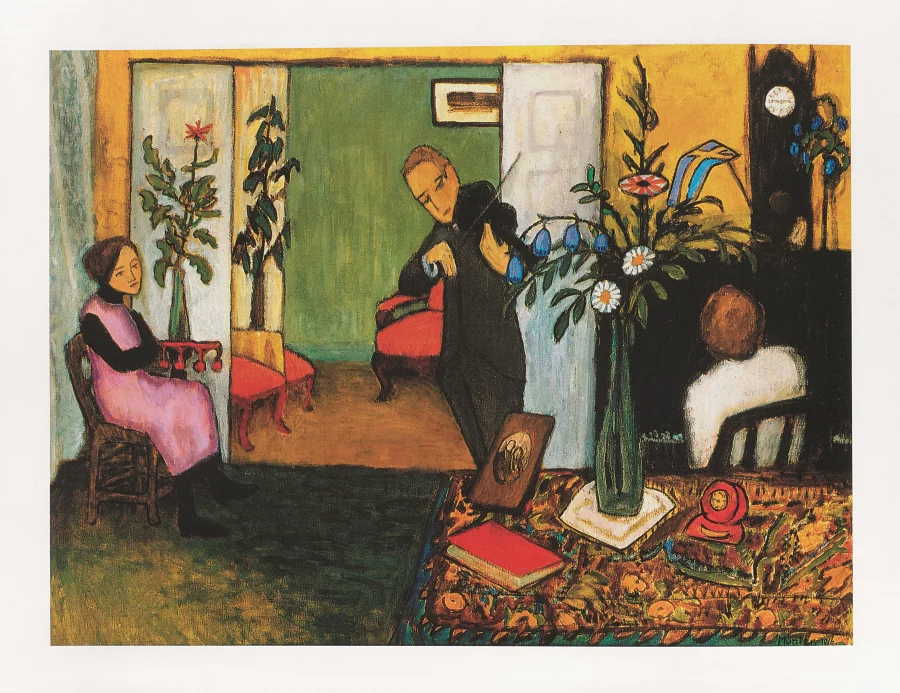
 This is a story about a missing painting, from an artist you may never have heard of. Though she helped shape European modern art, German artist Gabriele Münter's work was quickly overshadowed in the public's mind by her 12-year relationship with noted abstract artist Wassily Kandinsky.
She met Kandinsky in Munich in 1902, and with his tutoring, she "mastered color as well as the line," she told a German public broadcaster in 1957. Together with other artists, they founded an avant-garde arts collective called Der Blaue Reiter (The Blue Rider) in 1911.
At the time, most modern artists, like Kandinsky, were moving toward more and more abstract work. Not Münter. In her paintings, people look like people and flowers look like flowers. But her dazzling colors, simplified forms and dramatic scenes are startlingly fresh; her domestic scenes are so immediate that they feel like you've interrupted a crucial, private moment.
"Gabriele Münter was so pioneering, so adventurous in her adherence to life," said Megan Fontanella, curator of modern art and provenance at the Guggenheim Museum in New York City. "She is revitalizing the still life, the landscape, the portrait genres, and presenting them in these really fresh and dynamic ways."
Yet, perhaps due to her relationship with Kandinsky, her work was rarely collected by important museums after her death in 1962 (she herself said she was seen as "an unnecessary side dish" to him), and so her paintings largely disappeared from the public eye.
Now Münter is having a moment, with exhibitions this year in Madrid and Paris, as well as one currently at the Guggenheim in New York. The New York show is an expansive one and includes American street photography in the late 1890s, alongside over 50 paintings, from her dazzlingly colored European landscapes to portraits capturing the expressive faces of people she knew.