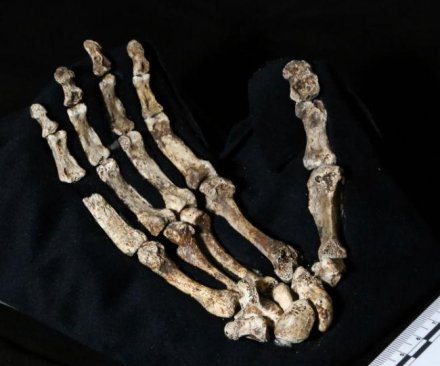
 Scientists say they've discovered a new member of the human family tree, revealed by a huge trove of bones in a barely accessible, pitch-dark chamber of a cave in South Africa.
The creature shows a surprising mix of human-like and more primitive characteristics — some experts called it "bizarre" and "weird."
And the discovery presents some key mysteries: How old are the bones? And how did they get into that chamber, reachable only by a complicated pathway that includes squeezing through passages as narrow as about 7½ inches (17.8 centimeters)?
The bones were found by a spelunker, about 30 miles (48 kilometers) northwest of Johannesburg. The site has yielded some 1,550 specimens since its discovery in 2013. The fossils represent at least 15 individuals.
Researchers named the creature Homo naledi (nah-LEH-dee). That reflects the "Homo" evolutionary group, which includes modern people and our closest extinct relatives, and the word for "star" in a local language. The find was made in the Rising Star cave system.
 Down a short gravel track in a largely nondescript corner of Louisiana sits a gas processing...
 Netia McCray recalls how excited she was to join the federal advisory committee on long COVID...
 A 10,000 year-old tooth in remarkable condition from an ancient Pacific mastodon, a large mammal that...
 The universe is a strange place — filled with exploding stars, ancient galaxies, and unseen worlds....