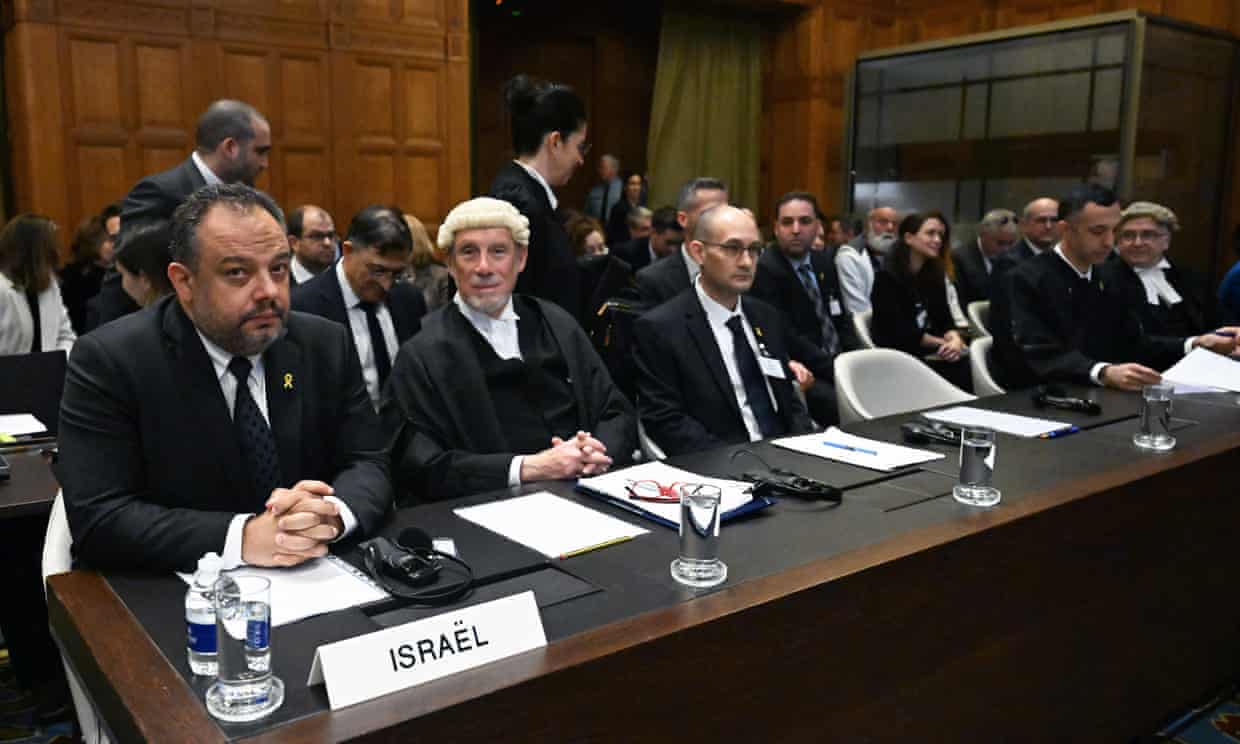
Watching lawyers for South Africa and Israel debate whether Israel is committing genocide in Gaza was like observing two versions of reality that barely intersect.
Each set of counsel, appearing before the international court of justice at The Hague, largely avoided the most powerful evidence contradicting their case, and the absence of a factual hearing or any questioning left it unclear how the judges will resolve the dispute. Yet I would wager that South Africa’s case was strong enough that the court will impose some provisional measures on Israel in the hope of mitigating the enormous civilian harm caused by Israel’s approach to fighting Hamas.
Genocide, as defined in a widely ratified treaty, has essentially two elements. First, an offender must commit certain acts against a targeted group such as “killing” or “deliberately inflicting … conditions of life calculated to bring about its physical destruction in whole or part”. Second, these acts must be committed with genocidal intent, meaning an “intent to destroy, in whole or in part, a national, ethnical, racial or religious group, as such”. Both parts of the crime were deeply contested by the lawyers in The Hague.
 Nearly fifty years after the infamous Red Army Faction trials, Germany’s maximum-security Stammheim Prison is once...
 Denmark’s government was cautiously optimistic on Saturday following Donald Trump’s announcement of a deal on Greenland...
 Israel plans to seek additional US weapons and defence capabilities as "compensation" after Washington approved the...
 When Israel deployed its Iron Beam laser weapon for the first time last December, the announcement...