

 An Israeli security plan presented to the United States demands that any future Palestinian state not have defense forces or weapons.
According to the plan, Israel would set up alarm stations on the West Bank hills, deploy forces to the Jordanian border and exercise full control over Palestinian airspace.
The plan has drawn angry reactions from Palestinian political groups, who argue that the proposals would completely erase the concept of an independent Palestinian state.
 A former Marine sergeant facing the first federal civilian prosecution of a military member accused of a war crime says there is much more at stake than his claim of innocence on charges that he killed unarmed detainees in Fallujah, Iraq.
 Paul Hoffman, high-ranking Interior official, resigns - Hoffman, who got his post thanks to Vice President Dick Cheney, regularly helped the veep undercut environmental regulations, according to a Washington Post investigation published last year. From keeping the Yellowstone cutthroat trout off the Endangered Species List to helping lift the Clinton-era ban on snowmobiling in Yellowstone National Park, Hoffman, former director of the Cody, Wyo., Chamber of Commerce, made sure that commerce in his and Cheney's home state wasn't unduly burdened. Hoffman also overrode the decision of the Grand Canyon's park superintendent to remove biblical plaques from the park, and forced its bookstores to stock a creationist text claiming the canyon was created in six days a few thousand years ago. More recently, he tried to rewrite national park management rules to give snowmobiles and off-road vehicles free rein and allow commercial activities, like mining and rock concerts. Perhaps Interior will bleed a bit more green now.
 Russian forces are advancing towards Tbilisi, according to the Georgian government, despite a fragile ceasefire being agreed by the two sides.
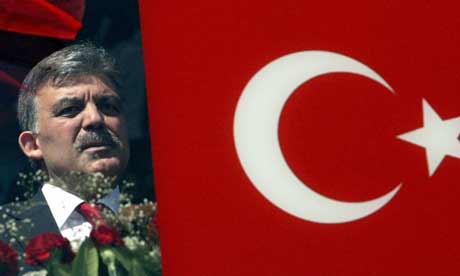 "I don't think you can control all the world from one centre," Gül told the Guardian. "There are big nations. There are huge populations. There is unbelievable economic development in some parts of the world. So what we have to do is, instead of unilateral actions, act all together, make common decisions and have consultations with the world. A new world order, if I can say it, should emerge."