Environmental Glance
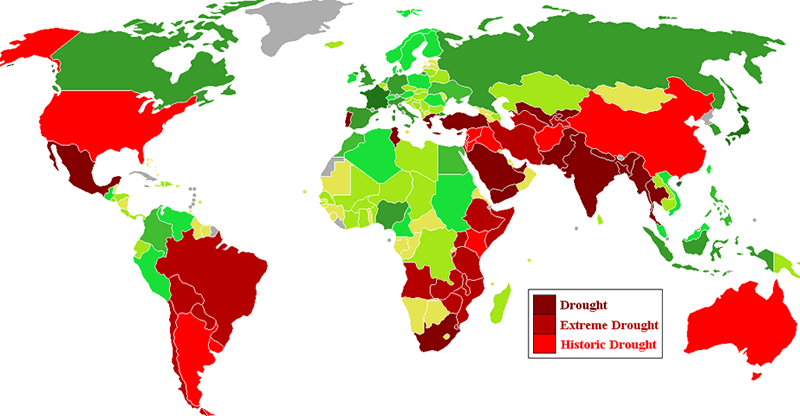 The countries that make up two thirds of the world's agricultural output are experiencing drought conditions. Whether you watch a video of the drought in China, Australia, Africa, South America, or the US , the scene will be the same: misery, ruined crop, and dying cattle.
Catastrophic Fall in 2009 Global Food Production
Acid oceans 'need urgent action'
 The declaration, supported by Prince Albert II of Monaco, builds on findings from an earlier international summit.
More than 150 top marine researchers have voiced their concerns through the "Monaco Declaration", which warns that changes in acidity are accelerating.
Interior Ignored Science When Limiting Water to Grand Canyon
 Interior Department officials ignored key scientific findings when they limited water flows in the Grand Canyon to optimize generation of electric power there, risking damage to the ecology of the spectacular national landmark, according to documents obtained by The Washington Post.
A Jan. 15 memo written by Grand Canyon National Park Superintendent Steve Martin suggests that the department produced a flawed environmental assessment to defend its actions against environmentalists in court.
India's Waterways A Toxic Stew of Pharmaceutical Chemicals Dumped from Big Pharma Factories
Many of the pharmaceuticals consumed in the United States are made in India, where labor is cheap and environmental laws are lenient on powerful corporations. U.S. drug companies are exploiting this situation to manufacture hundreds of millions of doses of high-profit pharmaceuticals in India, where ingredients purchased for a few cents can be re-sold to U.S. health patients for hundreds of dollars (the markup on some drugs is literally over 500,000%).
There's something else Big Pharma doesn't want you to know about its drug operations in India: Big Pharma's manufacturing facilities dump millions of doses of toxic pharmaceutical chemicals directly into India's waterways.
Ecologists warn the planet is running short of water
A swelling global population, changing diets and mankind's expanding “water footprint” could be bringing an end to the era of cheap water.
The warnings, in an annual report by the Pacific Institute in California, come as ecologists have begun adopting the term “peak ecological water” — the point where, like the concept of “peak oil”, the world has to confront a natural limit on something once considered virtually infinite.
The world is in danger of running out of “sustainably managed water”, according to Peter Gleick, the president of the Pacific Institute and a leading authority on global freshwater resources.
Antarctic ice shelf set to collapse due to warming
More...
Top 11 compounds in US drinking water
 A comprehensive survey of the drinking water for more than 28 million Americans has detected the widespread but low-level presence of pharmaceuticals and hormonally active chemicals.
Little was known about people's exposure to such compounds from drinking water, so Shane Snyder and colleagues at the Southern Nevada Water Authority in Las Vegas screened tap water from 19 US water utilities for 51 different compounds. The surveys were carried out between 2006 and 2007.
The 11 most frequently detected compounds - all found at extremely low concentrations - were:
More Articles...
Page 187 of 203