




 The US Central Command (Centcom) said it targeted Iran as it posed an "imminent threat" in the Strait of Hormuz.
In a post on X, Centcom described Iranian accusations against Washington saying it committed an act of aggression as "absolutely FALSE".
"U.S. forces took limited, precise action against IRGC minelaying forces posing an imminent threat in the Strait of Hormuz," Centcom wrote.
"In essence, Iran created the threat and the U.S. military eliminated it to protect civilian mariners, commercial shipping, and the free flow of global commerce."
The statement comes after US forces targeted two launchers on Iran's Larak island late on Sunday, marking the first known American attacks on the country since late July.
US carries out first strike on Iran since July
Rep. Jim Clyburn says impeaching Trump shouldn’t be Democrats’ priority if they win back the House
Rep. Jim Clyburn, D-S.C., said Sunday that Democrats should not prioritize impeaching President Donald Trump if they win control of the House in the upcoming midterm elections, but instead should focus on making life more affordable for Americans.
Clyburn told NBC News’ “Meet the Press” that if Democrats take back the House, he feels confident that their first order of business would be making the country accessible and affordable for all citizens.
Pressed on whether he believes Democrats should rule out the prospect of impeaching Trump if they regain control of the House, the South Carolina lawmaker said, “I don’t rule it out, but I don’t rule it in.”
“I don’t think that should be our priority if we get into office,” he added. “Our priority ought to be making housing, education, energy, healthcare affordable and accessible for all of our citizens. Impeaching the president will not do that.”
The U.S. relied on these science advisers. Then the Trump administration cut them
 Netia McCray recalls how excited she was to join the federal advisory committee on long COVID in 2025. She had been diagnosed in the early days of the pandemic — and symptoms such as fatigue, heart palpitations and shortness of breath had become a frustrating but inescapable part of life.
By joining this group of doctors, researchers and other experts advising on the disease, McCray, 36, had hoped to channel her years of experience as a long-COVID patient into "something that could benefit so many individuals like myself and my community," she says. The work, she felt, could make her part of the solution for a debilitating condition that impacts millions of Americans.
But McCray had only been on the committee for a few months when she received an email notice that the group was terminated, "effective immediately."
McCray's advisory group is one of more than 100 science-focused federal committees that have been terminated under the second Trump administration, according to a news analysis in the journal Nature. As of March of this year, more than a quarter of the country's healthcare-related committees have been shut down, according to the advocacy group Public Citizen.
At least 20 people missing after Grand Canyon flash flood near Bright Angel Canyon, Phantom Ranch
 Severe flash flooding in the Grand Canyon on Saturday caused significant damage to infrastructure, forced the evacuation of over 60 people and has left more than a dozen missing.
At least 62 people have been evacuated from Phantom Ranch and the lower North Kaibab rail to the South Rim by the Arizona Department of Public Safety and National Parks Service, according to a release by NPS. Additional evacuations were scheduled at the Cottonwood Campground and Phantom Ranch for Sunday.
At least 20 people are missing or unaccounted for, according to the NPS. Anyone who knows hikers or campers who were in the area at the time should contact the National Park Service Investigative Services Branch.
Flooding near Bright Angel Canyon and Phantom Ranch has destroyed several structures and damaged other infrastructure and utilities.
The Black Bridge and Silver Bridge crossing the Colorado River and nearly all footbridges crossing Bright Angel Creek were destroyed by the flooding, and several trails, including the North Kaibab Trail, are closed.
Tom Martin, a Grand Canyon River Runner, said torrential rain fell on the Dragon Bravo fire scar and debris poured down the North Rim of the canyon, resulting in large debris flows.
US says around 85 Americans remain missing after Nepal flood
 About 85 Americans remain missing after a devastating flood swept through a remote region of the Nepali Himalayas, the State Department said on Sunday.
The US figure is just a small fraction of the more than 2,500 people that remain missing after the disaster.
Some 781 people have been confirmed dead by authorities after the wall of water, mud and debris tore through the region and overwhelmed entire villages early Wednesday.
State Department spokesman Tommy Pigott told ABC talk show “This Week” that nine Americans have been evacuated and that he was unaware of any US nationals dying in the disaster.
“The remoteness of this location makes getting reliable information difficult. But our dedication remains, our commitment remains,” Pigott said.
Former Israeli spy detained by ICE in US
A transgender Israeli woman who served in Israel’s military intelligence directorate is facing deportation from the US after being convicted of imprisonment.
US Immigration and Customs Enforcement (ICE) said on Thursday that it had detained Alon, "a criminal illegal alien from Israel, during targeted operations in Concord, New Hampshire”. ICE used Alon’s former first name, Avishay.
“Alon’s criminal history includes conviction for criminal threat against person with deadly weapon, kidnapping, and drug possession,” ICE said on social media.
Alon previously served in the Israeli military’s Unit 81, considered one of the military’s most highly classified divisions, specialising in technology for the Intelligence Directorate's special operations.
The Jerusalem Post cited Alon’s lawyers saying that, after serving in Unit 81, Alon transitioned gender, and held senior engineering roles in Amazon and Microsoft.
Over 113,000 Russians Flee to Georgia Amid Draft Rumors
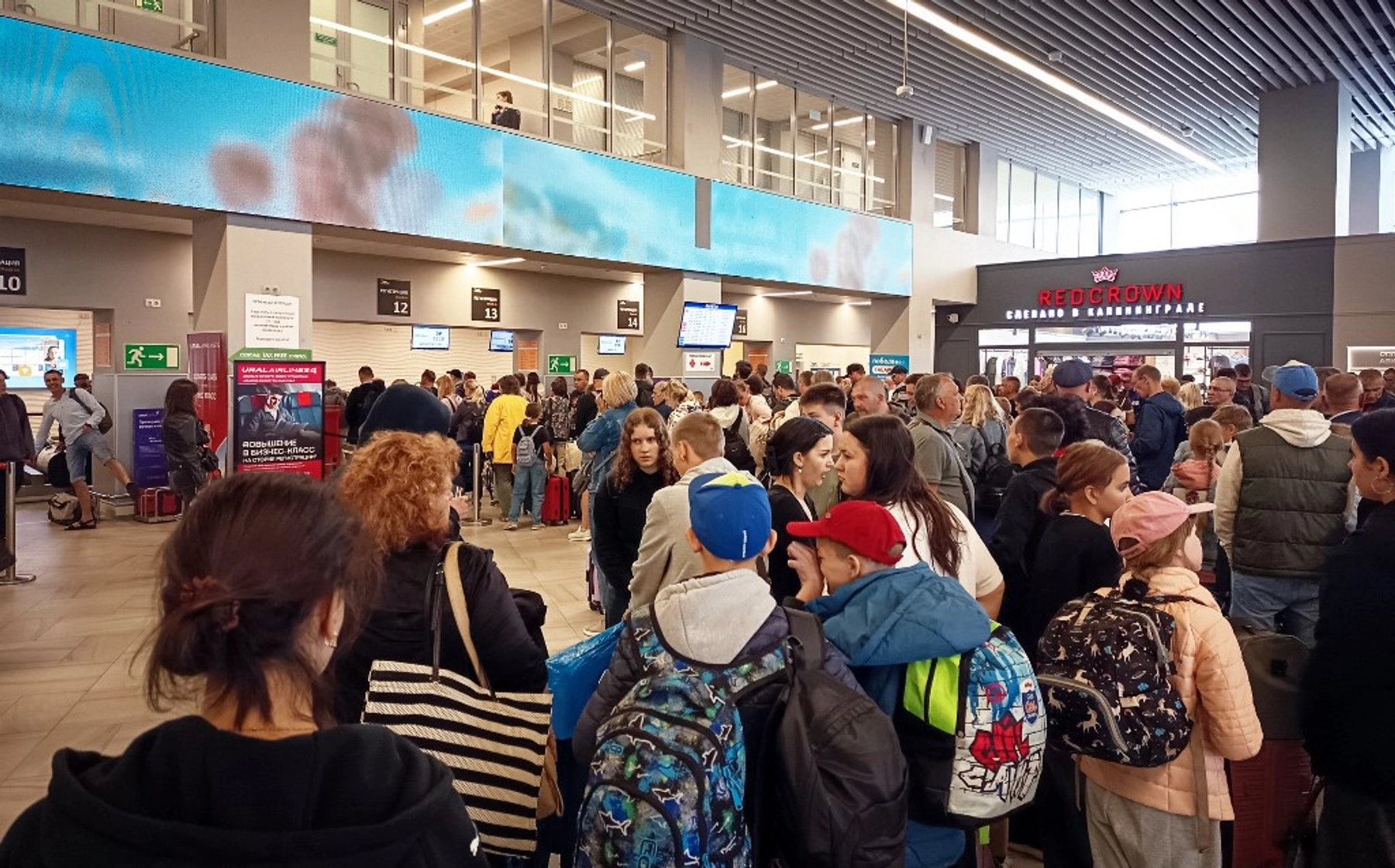 More than 113,000 Russian citizens crossed into Georgia through the Verkhny Lars checkpoint over the past week following rumors of a new military draft, Politico reported
On Aug. 20 alone, over 20,000 people crossed the border. Russia’s Federal Customs Service confirmed the figures significantly exceed crossing levels from previous years.
Armenia is also preparing for a potential influx of draft evaders. Alen Simonyan, Secretary of the Security Council of Armenia, told TV Rain that Yerevan will not hinder those seeking to avoid being sent to the Ukrainian front.
“To a Russian person, I can say only one thing: ‘Welcome to Armenia,’” Simonyan said, as cited by The Moscow Times. “Here they will find everything they were looking for... And they will return to Russia whenever it is convenient for them.”
Michigan Senate candidate Mike Rogers says he saw Bin Laden’s body with his ‘own eyes’. He did not
 In a recent fundraising email, the Republican candidate for Michigan’s open US Senate seat, former congressman Mike Rogers, appeared to mislead supporters about his past by suggesting that he had played an active role in the killing of Osama bin Laden, the leader of al-Qaida who was shot and killed in an American military raid on his compound in Pakistan in 2011.
“When I served as a US army officer and an FBI special agent, I swore a sacred oath to defend the United States against all enemies, foreign and domestic,” Rogers wrote, according to a screenshot of the email shared online by Azi Paybarah, a former Washington Post reporter now with Straight Arrow News. “I dedicated my life to keeping our families safe – working in the shadows, hunting down terrorists, and standing on the frontlines of our national security.”
He then added, in a section of the email highlighted in bold type: “I saw the dead body of Osama bin Laden with my own eyes, knowing that together, we had delivered justice for America.”
Rogers, however, was not in Abbottabad, Pakistan, on 1 May 2011, when Bin Laden was shot and killed – nor was he in the White House Situation Room, where then president Barack Obama and senior administration officials at the time, including Joe Biden and Hillary Clinton, followed the raid in real time.
Fire in California’s Big Sur region doubles in size overnight, forcing evacuations
 A fire in California’s Big Sur region doubled in size overnight, forcing the evacuation of nearby residents, in a coastal region where firefighters have battled another blaze for weeks.
The Plaskett fire, which sparked on Tuesday, had swept through more than 5,900 acres (2,400 hectares) in Monterey county as of Friday, and remained un-contained, according to Cal Fire. Its cause is under investigation.
Fire authorities have deployed helicopters and air tankers to suppress the flames with targeted water drops, but the remote area’s steep terrain and scarce roads have hindered ground crews’ ability to access the fire.
Meanwhile, to the north, the Timber fire continues to burn through more than 24,000 acres (9,700 acres), as authorities have it under 21% containment. The blaze broke past certain containment lines. Smoke from the fire and cloud cover prevented officials from mapping the fire’s expansion overnight.
More Articles...
- Trump’s DHS is using an obscure law to secretly snoop on journalists, non-profits and unions: ‘It’s outrageous’
- Judge says Pentagon's measures against Anthropic were 'illegal and baseless'
- Milo Yiannopoulos, far-right critic of U.S. immigration, is deported from U.S.
- Dozens of Israeli settlers attack flashpoint West Bank village
Page 11 of 1167