Science Glance
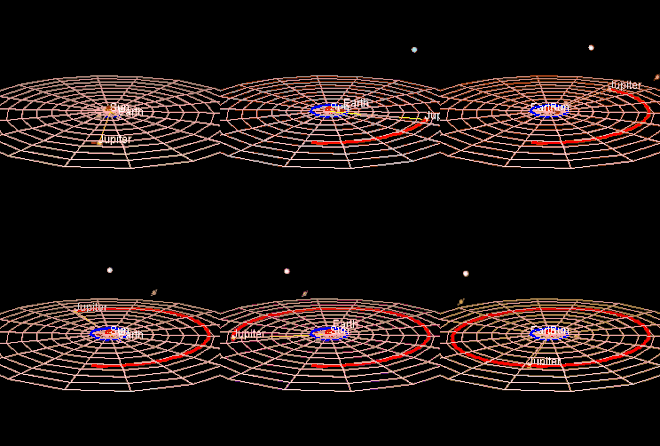 Want to explore the solar system and follow NASA space missions in real time?
The National Aeronautics and Space Administration is giving the public the chance to do just that through a new Internet-based tool called Eyes on the Solar System. The space agency said the tool combines video-game technology and NASA data to create an environment for users to ride along with agency spacecraft as they explore the cosmos.
NASA launches Web tool to explore the solar system
Scientists Create World's First Molecule-Sized Electric Motor
 Researchers at Tufts University in Massachusetts have created the world's smallest electric motor, the size of a single molecule, recently publishing the results in the scientific journal Nature Nanotechnology. Although applications for the nanoscale device are a long way off, the achievement could one day lead to nanoscale machines capable of performing surgery on a single cell, for instance.
The motor is made of a single molecule of butyl methyl sulfide—basically a sulfur molecule with two "arms" made of carbon and hydrogen atoms (the yellow-and-green dots in the middle of the photo to the left).
Astronomers discover planet made of diamond
Astronomers have spotted an exotic planet that seems to be made of diamond racing around a tiny star in our galactic backyard.
The new planet is far denser than any other known so far and consists largely of carbon. Because it is so dense, scientists calculate the carbon must be crystalline, so a large part of this strange world will effectively be diamond.
Life on Mars? Fossil find shows it's possible
 Scientists have found Earth's oldest fossils in Australia and say their microscopic discovery is convincing evidence that cells and bacteria were able to thrive in an oxygen-free world more than 3.4 billion years ago.
The finding suggests early life was sulphur-based -- living off and metabolizing sulphur rather than oxygen for energy -- and supports the idea that similar life forms could exist on other planets where oxygen levels are low or non-existent.
NASA reports breakthrough in space weather monitoring
 Thanks to data collected from NASA's Solar Terrestrial Relations Observatory (STEREO) and advances in modeling, scientists can for the first time watch a coronal mass ejection from its formation on the sun to its impact with the Earth's magnetosphere.
The most powerful CMEs, enormous magnetized clouds of electrified gas emitted from the sun, that hit the Earth's protective magnetic field can disrupt satellites, radio signals and even the electric grid.
Oxygen May Have Existed Undersea 300 Million Years Before Its Atmosphere Debut: MIT Scientists

Oxygen may have been present on Earth 300 million years before it was breathed into the atmosphere, scientists concluded from a new research.
Researchers from Massachusetts Institute of Technology discovered evidence that small aerobic organisms could have evolved to survive on extremely low levels of the gas in undersea "oxygen oases," keeping a low profile in the oceans before its debut in the atmosphere.
Darkest Planet Found: Coal-Black, It Reflects Almost No Light
 It may be hard to imagine a planet blacker than coal, but that's what astronomers say they've discovered in our home galaxy with NASA's Kepler space telescope.
Orbiting only about three million miles out from its star, the Jupiter-size gas giant planet, dubbed TrES-2b, is heated to 1,800 degrees Fahrenheit (980 degrees Celsius). Yet the apparently inky world appears to reflect almost none of the starlight that shines on it, according to a new study.
More Articles...
Page 40 of 63